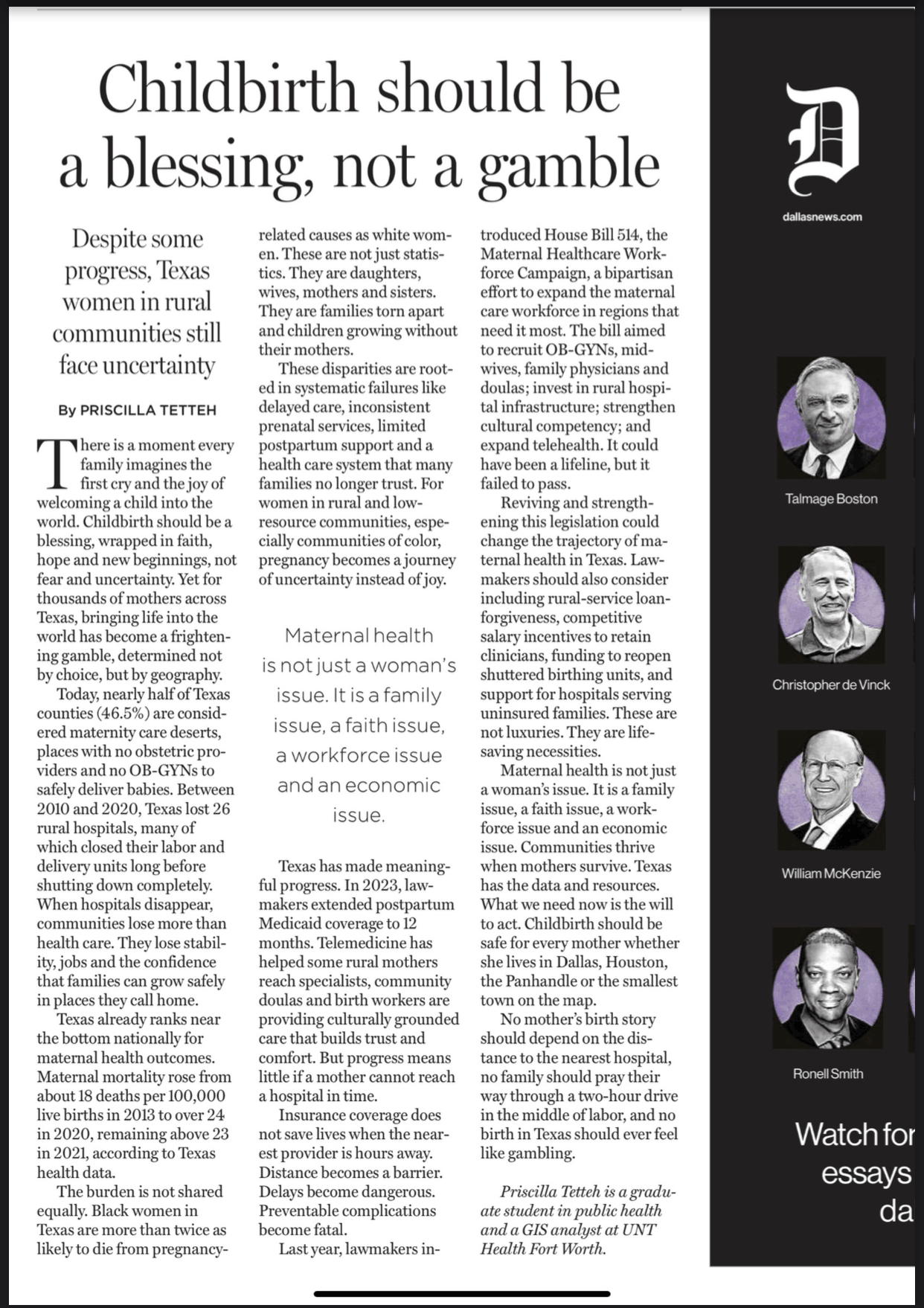
MS/PhD student amplifies maternal health access with the Dallas Morning News
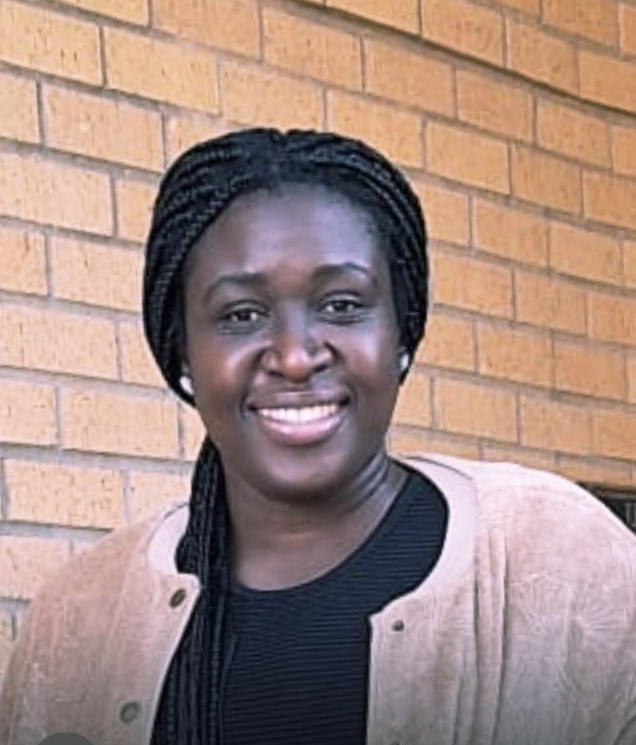
Priscilla Tetteh
By: Maya McMillian
Priscilla Tetteh, an MS/PhD student in the College of Public Health at The University of North Texas Health Science Center (UNT Health), published an opinion piece or “op-ed” with the Dallas Morning News during her first semester in the program. The piece reflects her growing engagement with maternal health, and the role policy plays in shaping access to care.
Priscilla is a student in the Health and Research Behavior program at UNT Health. While learning about the hospital closures across Texas during the COVID-19 pandemic, she became increasingly concerned about the implications for maternal health. Rising maternal mortality rates before and during the post–COVID-19 period prompted critical questions about where pregnant women, particularly those in underserved communities, seek emergency obstetric care when local hospitals close or reduce their services.
“Health care access is essential for expectant mothers,” says Priscilla. “And delayed care can lead to maternal mortality and morbidity.”
During her graduate studies at the University of North Texas (UNT) in medical geography with GIS training, Priscilla’s coursework deepened her interest in understanding how places shape health outcomes. She examined the living conditions of the populations most vulnerable to disease, the spatial distribution of health resources, and how socioeconomic constraints influence individuals’ ability to afford and access care within their regions. Her graduate thesis on maternal health care access strengthened her commitment to maternal and child health research. Through a spatial justice framework, Priscilla examines how geographic inequities, health care infrastructure, and community context intersect to shape maternal outcomes.
While taking courses with Dr. Stacey Griner, Priscilla analyzed existing policies affecting maternal health care access and identified a troubling trend in the continued expansion of maternity care deserts (regions with limited or no access to obstetric services). These regions are disproportionately located in rural and low-resourced communities. In her op-ed “Childbirth should be a blessing, not a gamble,” Priscilla discussed House Bill 514’s proposed legislation aimed at expanding the maternal health care workforce in areas already experiencing maternity care deserts. The bill ultimately did not pass, a development she describes as disappointing given its potential to slow the growth of maternal health care deserts and improve access to care for expectant mothers.
Priscilla also acknowledges the Dallas Morning News op‑ed workshop, hosted on campus in October 2025, as an influence in her decision to write and publish her own opinion piece. Attending the session helped her understand how personal narratives and evidence‑based arguments can drive public conversations.
“Hearing directly from the editors gave me the confidence to share my perspective,” she says. “It showed me that policy discussions need voices from the communities and fields most affected.”
As Priscilla transitions into her PhD program, she hopes to move beyond quantitative data analysis and observe the lived experiences of pregnant women across diverse communities by listening closely to their stories and examining how they navigate complex health systems.
“It’s important to understand the stories behind the data,” Priscilla explains, “Those stories have the power to inform policy.”
Priscilla aims to answer a central question: How can policy meaningfully respond to the structural barriers shaping maternal health outcomes? These issues include limited provider availability, long travel distances, insurance gaps, inconsistent prenatal care, and the broader social determinants that disproportionately affect rural and marginalized populations. Drawing on the results of her ongoing research, she intends to advocate for accessible health care for pregnant and postpartum women.
Priscilla credits the mentorship and guidance of faculty members Dr. Kari Northeim of UNT Health and Dr. Joseph Oppong of UNT for supporting her work from its early stages.
“They both mentored me and provided constructive feedback that helped me refine my academic interests and research goals,” says Priscilla. “The faculty in the College of Public Health create a supportive environment that reassures students they are in the right place and encourages community-centered approaches to improving health.”
Originally from Ghana, West Africa, Priscilla holds a bachelor’s degree in geography from Kwame Nkrumah University of Science and Technology. Her educational background has enabled her to view health systems and infrastructure through a geographic lens and as she continues her studies at UNT Health, she remains focused on understanding how health systems, places, and policy intersect to shape maternal health outcomes.